RandomX PoW
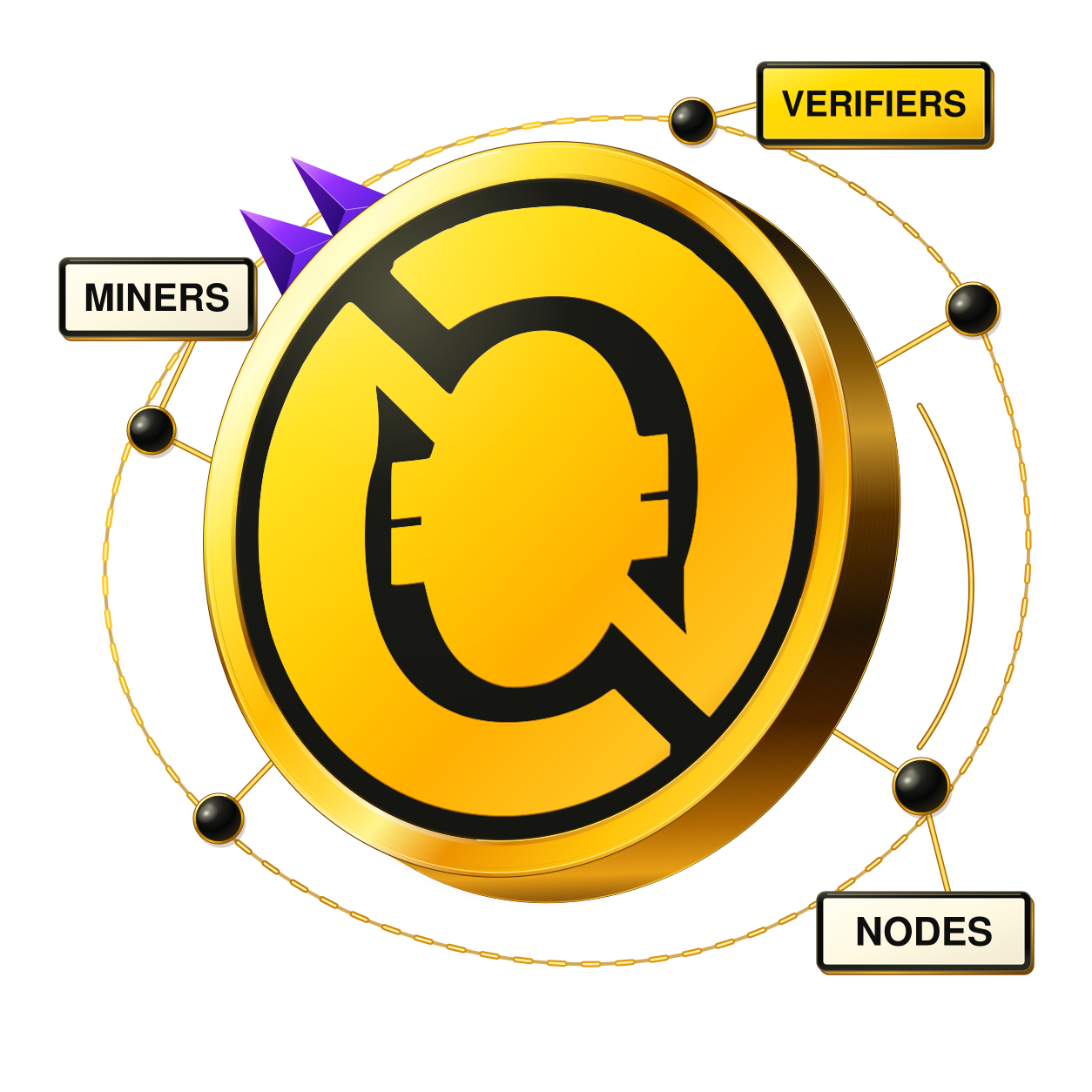
Miners produce new blocks and secure the blockchain through proof of work.
QWC MAINNET LIVE
Qwertycoin (QWC) is a privacy-focused cryptocurrency with open RandomX mining and EPoSe rewards for proven network services.
Open the Web Wallet, explore the blockchain or contribute on GitHub.
QWC MAINNET LIVE
Current blockchain and EPoSe data. Available values stay visible when some statistics are unavailable.
Miners produce new blocks and secure the blockchain through proof of work.
Service Nodes earn eligibility for network-service rewards through valid attestations.
Start here
Use QWC, contribute computing power or operate public network infrastructure. Each path has a current, official starting point.
Create or restore a QWC wallet in your browser, then send and receive private payments.
Open Web WalletJoin the official RandomX PPLNS pool with your QWC payout address. No pool account registration is required.
Start miningRun a public QWC node, register its service identity and qualify through verifiable EPoSe service proofs—without staking QWC.
Open operator guideAbout Qwertycoin
Use QWC for private payments, contribute computing power through mining or support the network as a Service Node.
 OPEN NETWORK
Send and receive QWC on an open network. Independent nodes verify transactions and maintain the blockchain.
 PRIVACY
QWC uses privacy technology to protect transaction details. Its open source code lets anyone examine how the network works.
 PoW
PoW
RandomX miners produce new blocks and secure the blockchain. Anyone can participate with compatible mining software.
 EPoSe
EPoSe
Service Nodes provide network services. Valid attestations establish eligibility, and the EPoSe protocol determines the reward rotation.
 NETWORK SERVICES
Service Nodes support the network and take part in EPoSe. No QWC staking is required; block production remains the job of RandomX miners.
 AVAILABLE
Use QWC directly in your browser with the Web Wallet. Explore the core software and contribute to its development on GitHub.

EPoSe
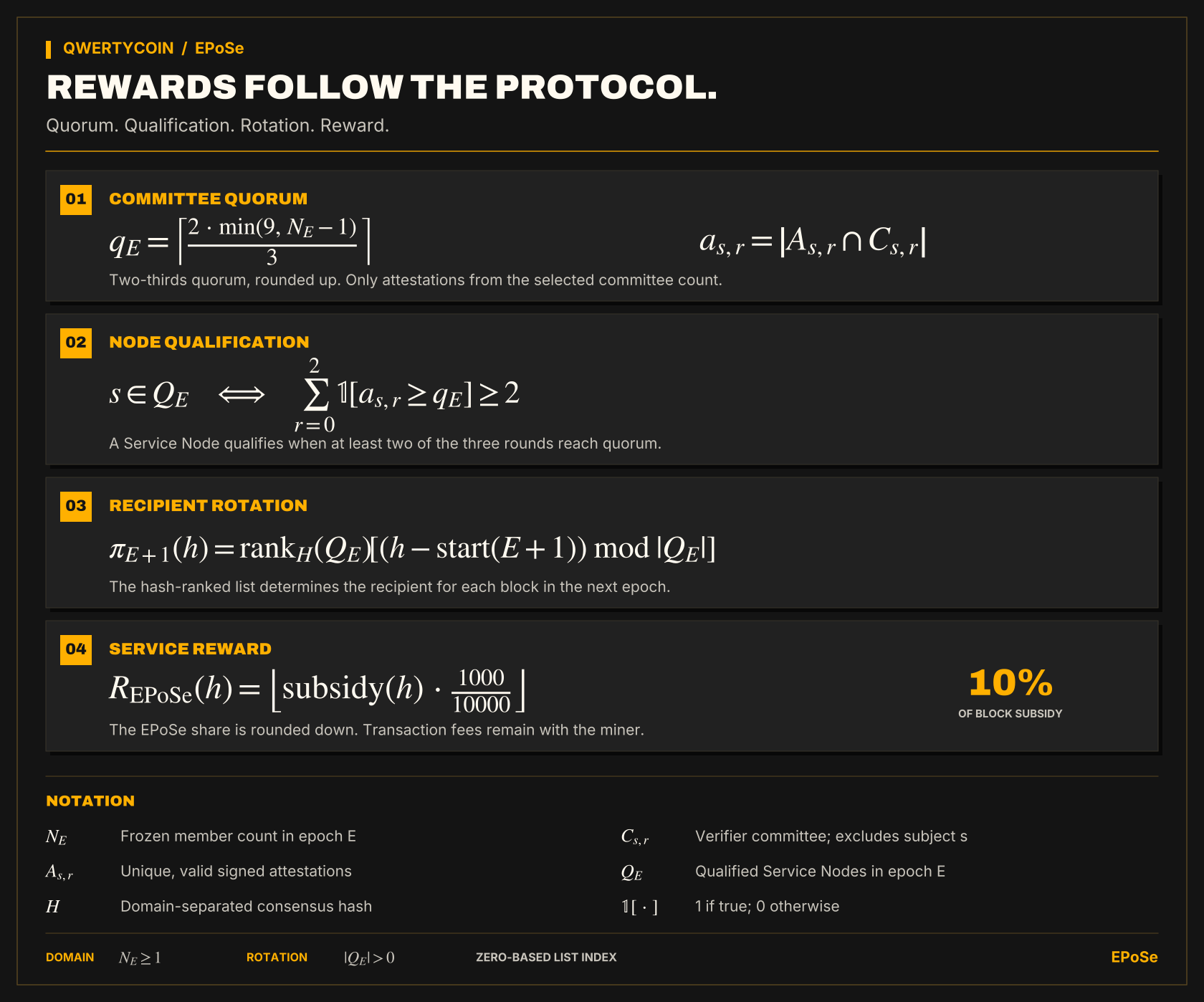
EPoSe rewards registered Service Nodes for proven network services. The protocol evaluates valid attestations recorded on the blockchain and determines which nodes qualify for reward rotation.
Registered Service Nodes provide network services during each epoch.
Protocol-selected verifiers check service responses and submit signed attestations.
After qualification is finalized, eligible Service Nodes enter the protocol's deterministic reward rotation.
EPoSe origin
Xecute developed the original EPoSe vision and contributed the Qwertycoin service-layer whitepaper. That work laid the foundation for rewarding useful network services.
Service Nodes
Every full node verifies and relays blockchain data. A registered Service Node also participates in EPoSe and can qualify for service rewards.
| Normal node | Service Node |
|---|---|
| Verifies blocks and transactions, synchronizes the chain and relays data. | Performs the same node functions and provides registered EPoSe services. |
| Operating a regular node alone does not earn EPoSe rewards. | Can qualify for service rewards through valid service attestations. |
| Can be operated independently of mining. | Requires EPoSe registration and service proofs, without QWC staking. |
Verifies blocks and transactions, synchronizes the chain and relays data.
Performs the same node functions and provides registered EPoSe services.
Operating a regular node alone does not earn EPoSe rewards.
Can qualify for service rewards through valid service attestations.
Can be operated independently of mining.
Requires EPoSe registration and service proofs, without QWC staking.
Mining
Contribute computing power to Qwertycoin. RandomX miners produce blocks at a target interval of 120 seconds.
Connect compatible RandomX mining software to a QWC node or a supported mining pool.
Mining secures block production. EPoSe separately rewards registered nodes for proven network services.
Official Qwertycoin pool
The official pool provides transparent PPLNS accounting, live statistics and automatic payouts. Your QWC payout address is your pool account; the pool never asks for wallet keys.
The block subsidy is split 90% to mining and 10% to EPoSe service rewards. Transaction fees remain with the miner.
From the mining rewards distributed through the official pool, 5% funds Qwertycoin development and pool operations; exactly 95% is allocated to participating miners before each account's payout transaction fee.
EXCHANGES
Find an exchange that lists Qwertycoin.
TRADING PAIR
QWC / USDT
TRADE QWCExternal exchange · neoxa.exchange
Wallets
The first public QWC test phase is open. The Web Wallet, Qwertycoin GUI 2.0.3, Core v2.0.3 command-line tools, the official Docker image and source code are available now.
Download the current Qwertycoin GUI from the official GitHub release. GUI v2.0.2 users must install v2.0.3 once with the direct download because the v2.0.2 updater cannot follow GitHub's release-asset redirect. The Windows Setup and macOS DMG are the preferred installers; portable ZIP and TAR.GZ packages remain available as alternatives. Verify the download and checksum before use.
Tested on the Windows Server 2025 runner · unsigned; older Windows versions were not verified
macOS 15 or newer
GLIBC 2.35 compatibility ceiling
Integrity note: SHA256SUMS verifies downloaded bytes, not publisher identity. Linux and Windows are unsigned; macOS is ad-hoc signed and not notarized.
Official Qwertycoin packages containing qwertycoind, qwertycoin-wallet-cli and qwertycoin-wallet-rpc. Verify the archive and checksum before use; release notes and audit status are documented with each GitHub release.
Tested on the Windows Server 2025 runner; no broader legacy-Windows claim
macOS 15 or newer
GLIBC 2.35 / GLIBCXX 3.4.30 compatibility ceiling
Integrity note: SHA256SUMS verifies downloaded bytes, not publisher identity. Linux and Windows are unsigned; macOS is ad-hoc signed and not notarized.
Run the verified Core release as a non-root Linux/amd64 container. Mainnet and the daemon are the defaults; the persistent named volume keeps chain data across container updates.
docker pull docker.io/qwertycoin/qwertycoin:latestdocker run -d --name qwertycoind --restart unless-stopped \
-v qwertycoin-chain:/data -p 8196:8196 \
docker.io/qwertycoin/qwertycoin:latestThe latest tag tracks the newest stable image. Audited production deployments may pin its image digest. Only P2P port 8196 is published below; administrative RPC is not exposed. Wallet and EPoSe identity data need separate protected volumes and the full quickstart.
Send, receive and manage QWC directly in your browser.
Explore the core software, build it yourself and contribute on GitHub.
Network
Current blockchain and EPoSe data.
EPoSe FAQ
Qwertycoin (QWC) is a privacy-focused cryptocurrency with RandomX proof-of-work mining and EPoSe rewards for proven network services.
Open the official Web Wallet, create or restore a wallet there and follow its safety instructions. The main website never processes wallet keys.
No. The current QWC network is separate from the earlier chain. Legacy wallet software and blockchain data are not compatible with this network.
No. RandomX miners produce blocks and secure the blockchain. EPoSe adds rewards for proven network services.
An epoch is the block period used to assess EPoSe service activity. It currently spans 720 blocks, approximately 24 hours at the target block interval.
A qualified Service Node has met the protocol's requirements for valid attestations in the relevant epoch and is eligible for service-reward selection. The technical quorum is at least ceil(2 x actual committee size / 3).
The EPoSe protocol. Every full node applies the same rules to valid on-chain registrations and attestations to verify eligibility and reward selection.
No. Participation requires EPoSe registration and the required service proofs, not locked QWC as stake.
Yes. Each Service Node needs its own valid registration and must meet the protocol's service requirements. Admission proof makes cheap identity creation harder.
EPoSe rewards proven service rather than locked stake. Service Nodes verify blockchain data like other full nodes, while RandomX miners perform proof-of-work block production.
Roadmap
Track the progress of Qwertycoin's network, wallets and developer tools.
RandomX network and core QWC functionality are live. Operators continue to maintain and improve the network.
Registration, service attestations, qualification and reward rotation are part of the current QWC network.
Monitoring, maintenance and operational improvements continue as regular network work.
The Web Wallet is available. PWA behavior, desktop software and additional tools keep their own status.
Core source code is available. Additional documentation, APIs and operator resources are tracked separately.
Extended services remain research topics and are not presented as current product functions.
History
Qwertycoin began in 2018. Today's network builds on that history with RandomX and EPoSe.
QWC began as a CryptoNote-based community privacy coin with early wallet, explorer, community and infrastructure efforts.
From 2019 to 2023, the project explored fair mining and network-service rewards alongside wallets, nodes and infrastructure. Xecute's EPoSe work shaped the vision of rewarding useful network services.
The token phase is part of Qwertycoin's history and separate from today's QWC network.
Qwertycoin starts a new network with private payments, RandomX mining and EPoSe service rewards.
Developers
Explore the core code, build the software and contribute improvements on GitHub.
Build and release information is tracked with the core repository and published resources.
Run a public EPoSe Service Node with the current Core operator guide. Open the EPoSe operator guide
Community
Follow development, explore the network and help shape Qwertycoin's next steps.